Most Palm Coast residents pass landmarks every day without knowing the people behind them. This article looks at the life and legacy of Alan Smolen, whose leadership during a critical period helped transform Palm Coast from a troubled development into a functioning community whose institutions continue to serve residents today.
A Leader at a Critical Moment
A Grand Haven resident traveling north on Colbert Lane to access Palm Coast Parkway will eventually pass the Alan Smolen Amphitheater at Daytona State College. How many have ever visited this outdoor performance space or know anything about the man for which it is named?
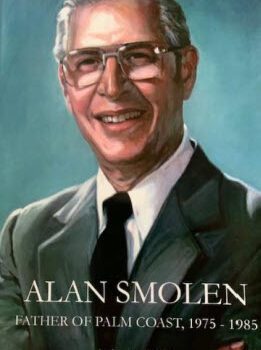
As Palm Coast approaches the 50th anniversary of its official Founding by International Telephone and Telegraph in October 1970 it’s appropriate to reflect on one of its most noteworthy leaders, Alan Smolen. He was the second President of ITT’s Community Development Corporation.
Palm Coast historian and Grand Haven resident Arthur E. Dycke describes the “talent, dignity, humanity and integrity” of this man in his book Alan Smolen: Father of Palm Coast, 1975 -1985.
In an excerpt from the book Dycke states, “In 1975 ITT faced ever growing charges of poor ecological canal planning, deceptive sales practices, shoddy construction and developer/government corruption. In that year Alan Smolen was brought in to clean up the mess and undertake the neglected work of developing a viable, vibrant community.”
A Lasting Civic Legacy
By all accounts Smolen was wildly successful in his efforts. He aided charities, all religious denominations and medical services; contributed land for fire departments, recreation areas, the library, and schools, including the Flagler/Palm Coast Campus of the former Daytona Beach Community College.
The outdoor pavilion dedicated in 1983 was originally named simply Building One. In a fitting tribute to the man who recognized the need for a cultural facility in Palm Coast the pavilion was renamed The Alan Smolen Center in 2007.
Today’s residents are the beneficiaries of this tremendous legacy.
By Kathy Reichard Ellavsky